
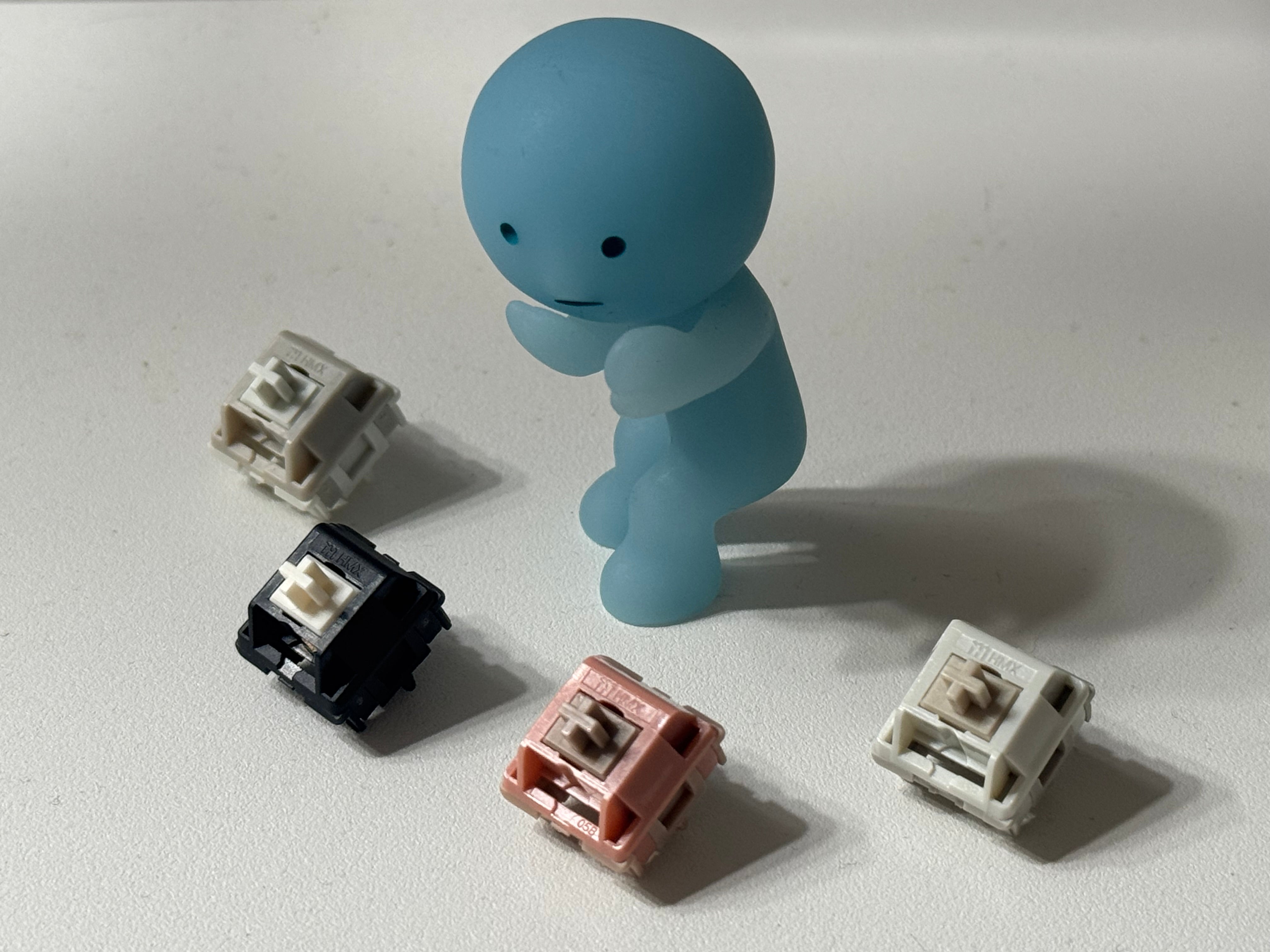
OVERVIEW
If you’re a keyboard enthusiast chasing that perfect blend of feel, sound, and aesthetics, the new HMX Retro switch lineup is a collection worth paying attention to. Featuring four distinct models (Retro C, Retro R, Retro T, and Retro J) the Retro lineup showcases HMX’s continued commitment to clean, consistent performance straight out of the box. In this breakdown, we’ll take a look at how each switch feels, sounds, and where they land in the ever-expanding landscape of switches.
HMX Retro Switches Reviewed
- HMX Retro C Linear
- HMX Retro R Linear
- HMX Retro T Linear
- HMX Retro J Tactile

TYPING FEEL
HMX Retro C Linear
The Retro C is one of the switches designed with a vintage colorway. For smoothness, the Retro is consistent with the HMX factory and feels perfect to use stock without having to hand lube. The steam and housings also have tight housing tolerances where the E/W stem wobble is almost nonexistent and the N/S stem wobble is only present when aggressively checking for wobble. The Retro C, along with the rest of the HMX Retro switches, are consistent with the well applied factory lube and tight tolerances that previous iterations of HMX switches have been known for.
HMX Retro R Linear
Retro R is another one of the HMX switches with a vintage colorway, reversed colors of the Retro C. Even though the Retro R is the reversed colorway of the Retro, the Retro R feels like the Retro C, the only difference is Retro C has 53g bottom out force vs 50g of Retro R. It is consistently smooth with the factory lube, and has tight housing tolerances for a clean and smooth typing feel.
HMX Retro T Linear
Similarly, the Retro T feels similar to the Retro C and Retro R switches. The Retro T PA66 housing material vs Retro C and Retro R uses PC top and PA66 bottom. For the cleanest and best out of the box typing feel, these HMX Retro linears are hard to beat.
HMX Retro J Tactile
The Retro J is the most unique feeling switch of this bunch. Mainly because it is a tactile switch made from a completely new mold by HMX. They have a similar aggressive tactile bump at the very start of the keypress, similar to tactile switches like the Gateron Type R, although they feel slightly more forgiving than the Gateron Type R due to the lighter spring weight. The Retro J also has a little bit of post-actuation linear travel which allows it to have a softer bottom out than an entirely tactile switch.
Compared to Gateron Azure Dragon V4, Retro J feels lighter. They both have a large tactile bump at the top of the keypress with a short linear travel right before bottoming out. The Retro J represents a good balance of a distinct tactile switch with a large bump that is still comfortable for extended typing with its light spring weight.
TYPING SOUND
HMX Retro C Linear
The Retro C leans into the high pitched clacky sound profile that HMX has become known for. The bottom housing is made of a mixture of PA66 and fiberglass which allows it to not only have a high pitched sound signature, but also one that is bright and sharp. It is not the highest pitched or the loudest HMX switch, but it creates a nice balance of a full clacky typing sound.
Sound test coming soon
HMX Retro R Linear
The Retro R has a similar typing sound to the Retro C since they are made of the same materials and have similar specs. It is high pitched, sharp, and clacky. Even though they are almost mirror images of each other, the Retro R appears to sound a hair lower pitched relative to the Retro C, and that’s only if I am being nitpicky and sitting there doing an A/B testing. During normal typing however the Retro C and the Retro R sound and feel almost exactly the same.
Sound test coming soon
HMX Retro T Linear
The Retro T is the most different from the HMX Retro Linear switches in terms of sound. Since its housings materials are made entirely out of Nylon PA66, the Retro T has a relatively deeper sound profile than the Retro C or the Retro R which are made of a PC top housing and PA66 bottom housing. The Retro T is by no means a deep sounding switch but relative to other HMX switches it lies in the mid to lower end of the HMX pitch spectrum.
The Retro T also does not have the same sharp bottom out that the Retro C or Retro R produce. Instead, the Retro T produces a more fuller and resonant sounding bottom out. Its bottom out sounds closer to a full travel switch than a long pole short travel switch, even though it has a total travel distance of 3.5mm.
Sound test coming soon
HMX Retro J Tactile
For having a large tactile bump, the Retro J is not a thocky tactile switch like some popular switches in the market that were known for a large tactile bump, like the Boba U4T or Holy Pandas. The Retro J is more of a high pitched and clacky tactile switch. Not surprising since it is an HMX switch known for their clacky sound signature. The HMX Retro J can also be compared with the Akko Cilantro in terms of sound, they’re very similar but the Retro J is ever so slightly higher pitched than the Cilantro possibly due to the shorter bottom out travel of 3.0mm in the Retro J.
Sound test coming soon
NOTABLE COMPARISONS
Pitch (lowest to highest):
Retro T < Retro J < Retro R < Retro C
CONCLUSION
The HMX Retro lineup proves that nostalgic design and modern switch engineering can coexist effectively. Each switch in the series brings HMX’s hallmark consistency (smooth travel, clean sound signatures, and impressive factory tolerances) while still possessing their own individual characteristics. Whether you’re after bright clacky linears or a tactile with a pronounced tactile bump, the Retro family delivers a polished and ready to use experience that appeals to both newcomers and seasoned enthusiasts. With thoughtful material choices, distinct sound profiles, and new molds, the Retro lineup shows why HMX continues to be one of the switches to keep your eye on.
PERSONAL FAVORITE
My personal favorite is the HMX Retro J. Coming from a strictly linear switch user, I found something satisfying about the typing feel produced by the large bump of the Retro J while also not being too harsh on the bottom out. It provided a more controlled typing experience than other tactiles I have tried, making them especially convenient for use at work. Although I still prefer the feel and especially the sound of linear switches over tactile switches, I would recommend giving the Retro J tactile switches a try especially for those who usually use linear switches and have some curiosity about tactile switches.
HIGHLIGHTS
- HMX Retro C – Extremely tight stem tolerances for an exceptionally smooth, wobble-free linear typing feel with a sharp high pitched typing sound.
- HMX Retro R – Reversed Retro C colorway that offers the same premium feel and sound as the Retro C.
- HMX Retro T – All-Nylon PA66 housing that produces a deeper, fuller sound compared to other HMX linears.
- HMX Retro J – A brand-new tactile mold featuring a large, top-heavy bump with a slight post-bump linear travel for comfort and control.
👉 You can buy these switches on our site:
- HMX Retro C
- HMX Retro R
- HMX Retro T
- HMX Retro J
Share your thoughts in the comments and let us know if you have any questions!
Other Reading
Top Mechanical Keyboard Layouts: Which One is Right for You?
How to Build Your First Mechanical Keyboards: A Step-by-Step Guide
How to Mod Your Mechanical Keyboard for Better Sound and Feel
Ultimate HMX Switch Showdown: Sound Test & Switch Review
Best Creamy Tactile Switches 2025
Plate Material, Does It Make a Difference?
Share:
Top 5 Thockiest Linear Switches of 2025
PCB Stabilizers vs Plate Stabilizers – What’s the Difference?