
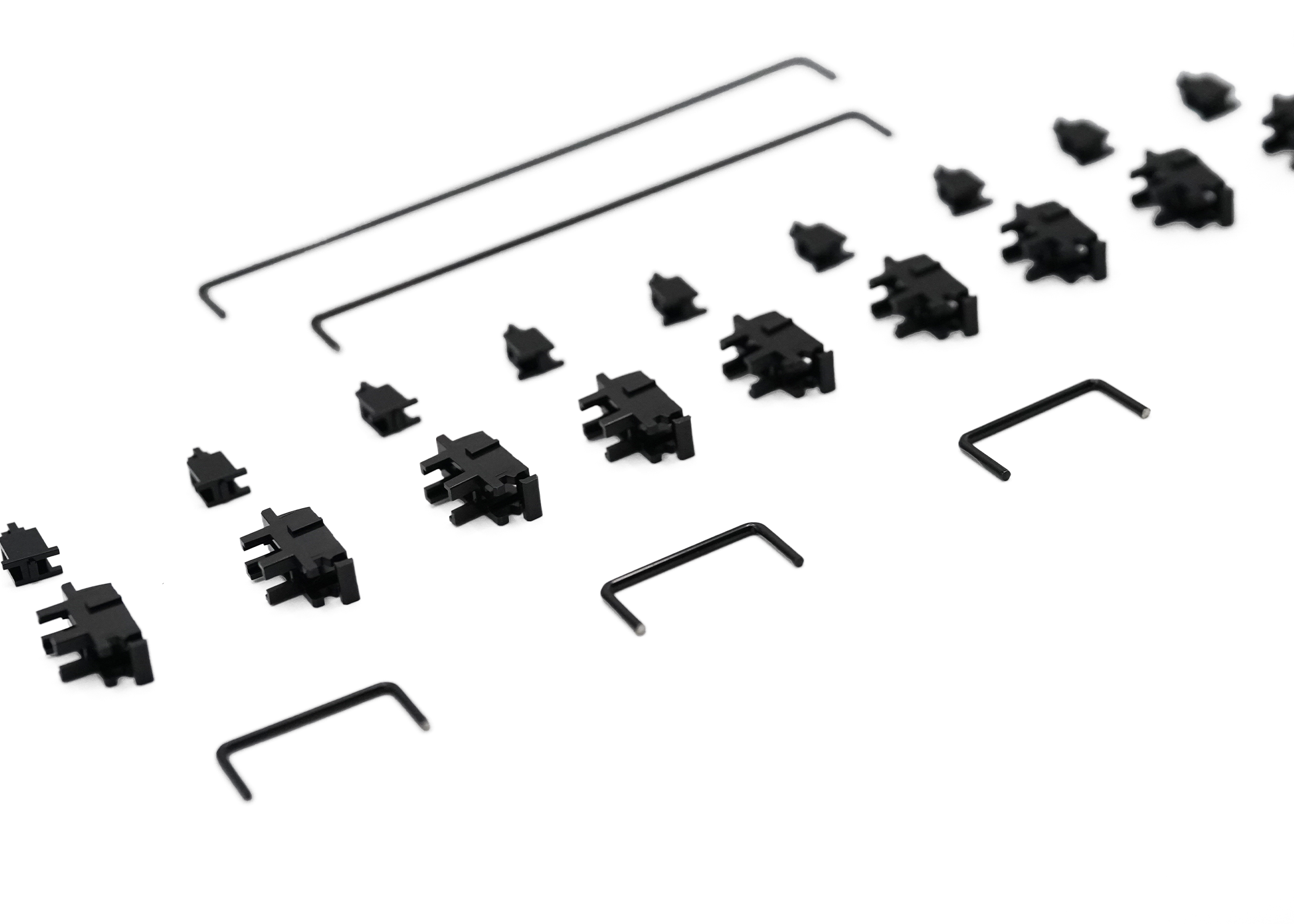
When building or upgrading a mechanical keyboard, stabilizers play a huge role in how your keyboard feels and sounds, especially on larger keys like the spacebar, enter, backspace, and shift. Two of the most common types you’ll encounter are PCB stabilizers and plate stabilizers.
So what’s the difference—and which one should you choose? Let’s break it down.
Stabilizers are components that prevent larger keys from wobbling when pressed off-center. Without stabilizers, wide keys would feel uneven, rattly, and inconsistent.
PCB stabilizers attach directly to the PCB (printed circuit board). They typically come in two types:
- Screw-in
- Clip-in
Pros
- Superior stability and consistency
- Less rattle when properly tuned
- Preferred many custom keyboard builders
- Perform well with flexible plates and gasket mounts
Cons
- Slightly more effort to install
- Requires a PCB that supports PCB-mounted stabilizers
Plate stabilizers clip directly into the keyboard plate, which provides their main support.
Pros
- Easier and faster to install
- Commonly used in prebuilt keyboards
- Compatible with PCBs that support plate mount stabilizers
Cons
- Less stable than PCB stabilizers
- More prone to rattle and ticking
- Harder to fine-tune
| Feature | PCB Stabilizers | Plate Stabilizers |
|---|---|---|
| Mounting | PCB | Plate |
| Stability | High | Medium |
| Rattle | Lower | Medium |
| Installation | Moderate | Easy |
Happy building! ⌨️✨
Share:
HMX Retro Switches Review
Top Silent Switches of 2026 – Full Guide & Sound Test Breakdown
1 comment
I’ve been looking into ways to improve my work setup and stumbled upon the Best ergonomic split keyboard for work. It sounds like it could be a game-changer for reducing strain, especially when paired with stabilizers.Check it out if you’re into setting up a more comfortable workspace.
https://www.elimkeys.com/